
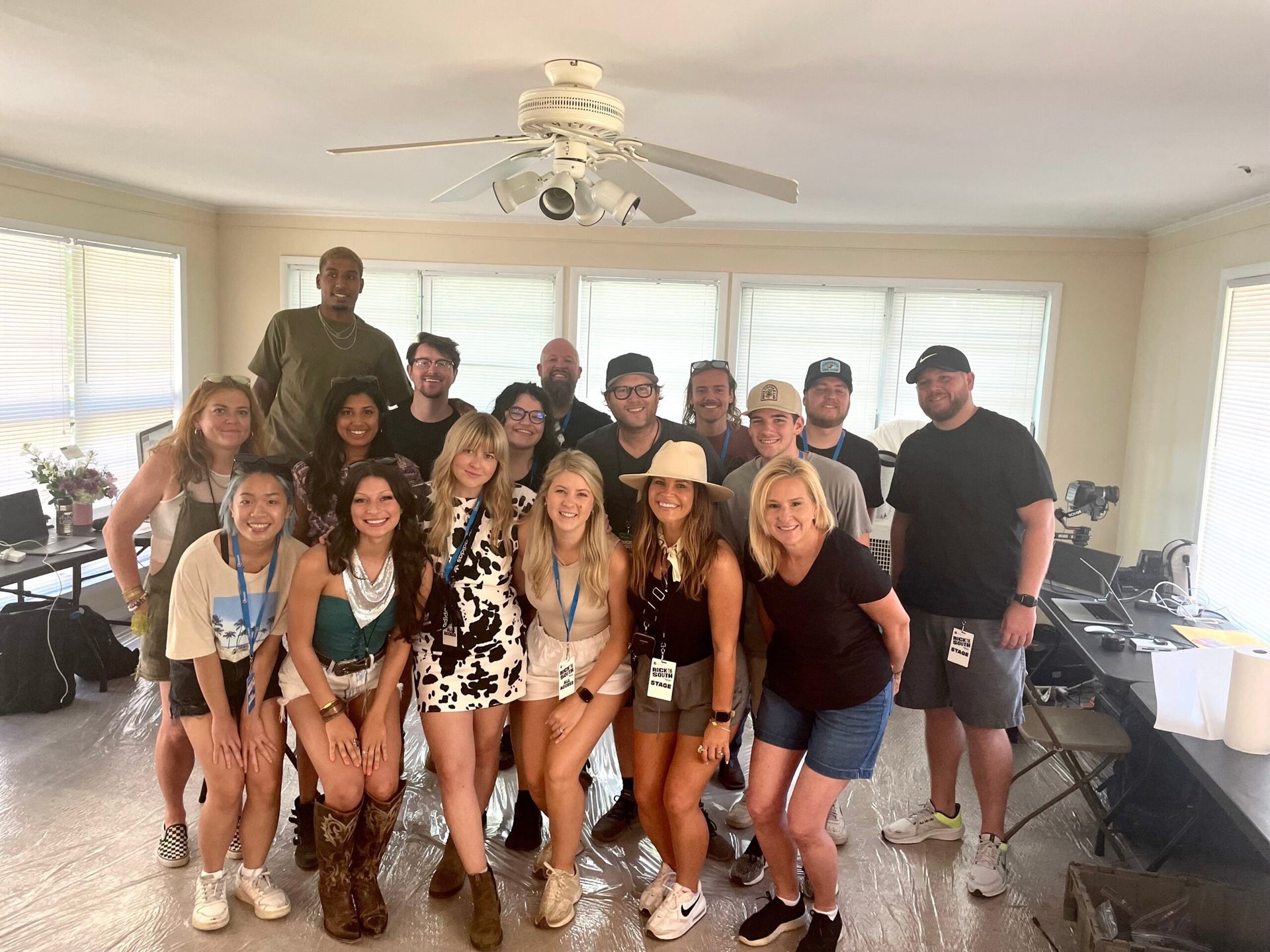
Just as the pandemic had us taking to our individual home offices—which for many of us meant kitchen tables or coffee tables—our office implemented two meetings per week. Attendance was ALWAYS required unless they were dead or on vacation. Dramatic? Maybe. But keeping a team together when we were all navigating the unknown of a pandemic—and on some level worrying about making it as a company—well, it felt like the right requirement. More than two years later, we are still having two meetings per week—both still with required attendance (unless of course you are dead or on vacation). The kick off meeting always happens on Monday morning. The purpose of this meeting is strategy—we are diving into what we finished lined last week, and what is on deck for this week. It ranges from 60-90 minutes, but normally runs just around one hour. Our internal traffic manager runs this meeting, and we prioritize based on biggest projects due that week. On Fridays though, things look different. We have a morning meeting that is just about checking in. Typically we watch a TED Talk during the week, and we discuss what we learned from it or how it challenged us—but then each teammate checks in. The epiphany I had during the pandemic was what my team REALLY needed from me: consistency. As an entrepreneur who has had to grow and earn the title CEO, consistency is not natural. I have made it a habit over the last several years to hire incredible humans that are all leaders. I know how rare it is to have a team full of people who are self-motivated, solution-oriented, make-it-happen humans. I know it’s rare because I’ve worked on many teams where that wasn’t the case. Truly, I think this exact team has grown into those characteristics because they feel so supported. Interdependent, and yet autonomous. Launching two meetings each week is something I think we will do forever. And listen—I’m the CEO that HATES meetings about meetings, or meetings that totally could have been a text—but these meetings are purposeful and create incredible momentum and impact. Today I wanted to focus on our Friday meeting, which is all about CULTURE. And if you are a leader, you already know this—culture is in the top three currencies your employees or future employees are using to measure whether they want to work with you or continue working for you. As leaders who are leading other leaders who are leading teams of people vital to our organization, we need to be fluent in what creates a culture worth staying in for the long haul. Here are the two most powerful culture building questions leaders can ask their teams: 1. What did you/your team accomplish that is worth celebrating? Encouraging our teams to see even the smallest victories is so important. If we don’t count the small wins, we could end up missing the really big ones too. By asking this question consistently, your employees will know it’s coming—and they will want to have something to share WORTH celebrating. I love this question because it forces all of us to focus on what went well, what problems we actually solved, and how even a small thing moved the needle. When we focus on these positive wins, we are reenforcing a culture of not just seeing it in yourself or your team, but in one another. As a CEO, it is incredible insight hearing how my leadership team spent their week by how they articulate their wins. 2. Who on our team is your hero this week, and why? Who is the Most Valuable Player to you and why? I cannot tell you how this has enriched our company culture. They know this question is coming every week, and it never gets old. Because it is NORMAL in our company to brag on a teammate for kicking butt, pitching in, hitting tight deadlines, and a myriad of other things. When your team becomes accustomed to finding the gold in the people they work with and calling it out, MAGIC HAPPENS. I can’t give you a real statistic on what percentage of change you will have if you consistently, weekly, ask these two powerful questions, but I promise it’s significant. The hardest part will be making space for a meeting dedicated just to connection. The second hardest part will be YOU, the leader, showing up, leading the charge, and participating. Challenge yourself to try it for a month, and then email me and let me know how it goes! I would love to hear from you!

Crafting and steering teams that drive revenue, or what many millennials and Gen Zers refer to as “salespeople” as if it were a term to be avoided at all costs, certainly isn’t a walk in the park, is it? My own journey spans over 17 years in the field, and I’ve found that with each passing day, the layers of complexity and nuance only deepen. In my early days as an eager salesperson, my eyes were firmly set on smashing sales targets. Yet, I was fortunate to grow within nurturing environments, under the guidance of leaders who genuinely cared. Remarkably, during my initial, formative years in the sales arena—as a driven, single mother striving in the sales profession—I had the privilege of working under two exceptional mentors. My role in a fire restoration company, which inherently demanded empathy, played a crucial role in shaping my approach. There, my duties extended beyond traditional sales; I often found myself switching from flashy stilettos to fire boots, offering a shoulder on some of the darkest days of our clients’ lives—their homes had been engulfed in flames. Balancing the drive to secure sales with profound empathy for the homeowners’ plight, I believe, was key to my rapid ascent to becoming the top salesperson across seven countries within a year. I entered the job confident in my sales abilities, yet the position challenged me to elevate the clients’ needs above my own ambitions. This philosophy of prioritizing the prospective client’s well-being over mere deal-closing has guided my approach for over 16 years and is something I endeavor to pass on to every naturally gifted salesperson I encounter. Since 2009, I’ve had the opportunity to train and lead over fifty sales professionals, work with diverse teams, and offer consultancy to organizations valued between $50 million to $1 billion, focusing on refining their sales processes and enhancing client experiences. Despite the variances in organizational needs and team dynamics, the core ‘WHY’ driving the most successful sales teams remains constant. Here are the key principles, in order of importance: Belief in the mission. Top salespeople are true believers in the solutions their companies offer, recognizing the meaningful impact of their work. This conviction in the company’s vision and its value proposition is a common trait among high achievers. Precise audience targeting. Successful salespeople thrive when they know exactly whom they’re selling to, making it easier to identify and connect with key prospects and influencers. Confidence in delivery. Elite sales professionals trust that what they sell will be delivered with excellence, reinforcing their confidence in the promises they make, which in turn, boosts their sales performance. Collaborative mindset. The best salespeople are proactive in seeking improvements, drawing on frontline insights to suggest enhancements in partnership with their leaders, fostering a culture of innovation and collaboration. Understanding urgency. Exceptional sales talent knows how to close deals by genuinely conveying the necessity of immediate action, a skill that significantly shortens the sales cycle. If you’re encountering obstacles with your sales team, it might be time to reassess these foundational aspects: Do your products and services inspire belief? Is your target audience clearly defined for your team, including key contacts and entry points? Does your team have unwavering confidence in your company’s ability to deliver with excellence? Is there a culture of collaboration encouraged by sales leadership? Does your team grasp how to create genuine urgency in closing sales? Navigating the complexities of leading high-performing sales teams is undeniably challenging, with no shortcuts to exceptional leadership. However, revisiting these fundamental principles can provide invaluable insights. For those seeking further guidance, the Good Grit Agency offers workshops that might serve as an excellent starting point, especially since they boast an expert who’s particularly passionate about refining sales processes.

Telling the story of your business, your journey, your team, and the people you serve is wildly important—but not quite as important as WHY you exist. An evocative story helps you create a deeper connection with current and potential clients/customers. Here are four ways you can spruce up the story of your business to drive deeper connection. After all, connection is our highest form of currency these days. TALK ABOUT WHY YOU LOVE WHAT YOU DO. It’s so important for companies and organizations to articulate their WHY—and you don’t just do this once. This is the thread you should try and weave through all of the content you put into the world: in your social media, on your website, and even when you are being interviewed by media. Your WHY will attract the right talent to work towards your dreams, and it will also attract the right customers! CELEBRATE YOUR TEAM AND THEIR MEANINGFUL CONTRIBUTIONS PUBLICLY. People LOVE knowing you love your team and your team loves knowing you see them and celebrate their contributions. It will also help you as the leader/owner to celebrate the wins. Unfortunately in business, we aren’t always winning—and damn I wish we were. So, when we do win, WE HAVE TO CELEBRATE. Talking about the wins—even the small ones—publicly helps us remember how to focus on the good, AND our customers LOVE seeing a company that lifts up their team members as the heroes. Choose someone on your team today and make a post about them! CREATE CONTENT THAT REFLECTS THE PROBLEMS YOUR BUSINESS IS SOLVING FOR YOUR CUSTOMERS REGULARLY. Look—like it or not, businesses are known by the problems we solve for our consumers. If you aren’t solving problems, what are you doing? A HUGE part of your brands story is the problems you are solving. Be the company that consistently talks about the solutions you are bringing to the table! Even if it seems super self explanatory, it’s always worth reminding your current and future consumers. SET BIG GOALS THAT MAKE A DIFFERENCE AND TELL PEOPLE! Be a catalyst for good. Have your team pick an organization that you love and is in line with your WHY, and start helping. I know what you are thinking… “We don’t have time to do something like that. We are barely getting what we need to get done as a business…” and I hear you. But what I’ve learned is that teams that CHOOSE to volunteer or pursue something to make the world better together are so much stronger than the ones that don’t. It can be as simple as a food drive for a neighborhood food bank, doing a 5k for a charity and training together, or better yet—ask YOUR TEAM to help choose a cause. And when you choose it—TALK ABOUT IT. Not to show off, but instead to inspire others to do the same! The legacy of your business is being written every day… so take an ACTIVE role in making sure it’s the story you WANT TO TELL . Is what’s out there how you want people to remember you? If not, CHANGE IT! And if you need help, Good Grit Agency would love to be a thought partner.

For the last 8 years I’ve been interviewing people—all different ages, all different roles, and personality types of all kinds—and here is what I know: interviewing is hard for both parties! As the interviewer, I have so much pressure on me to discern if this person is a good fit, and if they are truthful in their own evaluation of skills. Are they likable? Passionate? A good fit for culture? The list goes on and on. And as for the person sitting in the hot seat? Well, you need a job! And sometimes, depending how much you want said job—the little things seem to slip. So here ya go friends, my best advice for those of you trying to land the job of your dreams… or hey, the job for right now. 1. Do Your Homework. Nothing is more impressive than someone who shows up to an interview with something relevant about my business to discuss …or compliment, or ask a question. It’s enough to get me leaning into that person and really hoping they are a good fit. Listen, I own a magazine, one wildly distributed in most every US state. I can’t tell you how many people I’ve interviewed since it’s inception that tell me they “love it,” but they’ve never seen a hard copy. WHAT? No. Just no. The same goes for any brand—you may not have access to something tangible like a magazine for the company you are interviewing for, but read up on them—not just their website, but articles by other people. If it’s possible, you should find out more about the person interviewing you! It goes a long way to come in knowing enough to be interested. 2. Forget About Being Interesting, Be Interested. You have a limited amount of time to prove you are the perfect candidate for this job that you really want or NEED . I get it. We are all tempted to dive into hyper bragging—or at least the explanation of our skill set and what makes us the right person. But don’t do it. Don’t give into the temptation. Not yet. A first interview is the interview I’m trying to determine your likability, listening skills, curiosity, and relationship skills above all else. If you spend the first 30 minutes with me talking about yourself, I’m left scratching my head on those skills. Instead, ask questions! Interview the interviewer. “How long have you worked here?” “Tell me about the company culture?” “What other position within this company have you held?” Whatever you do, be interested . The more interested you are, the more interesting this interviewer will find you. 3. Find Out The Problem Your Position Will Be Solving. Now, I know this may seem redundant, but after showing up knowledgeable and inquisitive, then it’s time to move into some specifics about the particular position. You know what I always wish a potential candidate would ask me? “If this position could solve a problem for you, what would it be?” Honestly, if someone asked me this question, I would probably pass out. It’s brilliant. Not just because it makes you seem like you are a solution-oriented person (which is MY FAVORITE TYPE OF HUMAN ), it also gives you valuable intel. See, if you know a big problem, then you can really set yourself up to do homework for a follow up email or phone call… or if things go really well, a 2nd interview! 4. Ask For Homework. In my experience, my most successful working relationships have been built on project based building blocks. Time is a gift we don’t always have when we need a job (or when we need to fill a position quickly ), but don’t be afraid to offer up a quick project to highlight how you could solve that big problem they told you about. This shows you are hungry, and that you are more than a resume. There is nothing that inspires me and motivates me more than someone with initiative, a great attitude, and finish-line drive.